
Ink-to-render reveal
A 3D object draws itself in ink, shades in graphite, then turns into the real material. One progress value drives all three phases.
How it works
- Draw: dashed edge lines grow until the outline is complete (progress 0 to 0.34).
- Shade: the paper-white surface greys towards graphite (0.30 to 0.66).
- Life: the real colour and material arrive while the ink lifts away (0.62 to 1).
- The phases overlap on purpose, so no frame of the reveal sits still.
- Put RevealMaterial and InkEdges inside any mesh, then drive the progress ref from a timeline, scroll or a slider.
- Ink only follows edges where faces meet at more than 18°. Crisp shapes outline fully; very round ones, like DrawnRoundedBox, take the shading with little ink.
- Colours come from design tokens through readToken. Swap in your own values.
Source
npm i three @react-three/fiber @react-three/dreiimport { Edges, RoundedBox } from "@react-three/drei";
import type { EdgesRef } from "@react-three/drei";
import { useFrame } from "@react-three/fiber";
import { useMemo, useRef } from "react";
import type { MutableRefObject } from "react";
import * as THREE from "three";
import { readToken } from "../design/readToken";
/**
* Ink-to-render reveal. One progress value (0 → 1) drives three overlapping phases:
* draw (dashed ink contours trace the form), shade (paper greys into graphite), life (real material arrives, ink lifts).
*/
export type RevealRef = MutableRefObject<number>;
const drawEnd = 0.34;
const shadeStart = 0.3;
const shadeEnd = 0.66;
const lifeStart = 0.62;
const edgeLength = 14;
export function phaseDraw(value: number) {
return THREE.MathUtils.smoothstep(value, 0, drawEnd);
}
export function phaseShade(value: number) {
return THREE.MathUtils.smoothstep(value, shadeStart, shadeEnd);
}
export function phaseLife(value: number) {
return THREE.MathUtils.smoothstep(value, lifeStart, 1);
}
interface InkPalette {
ink: string;
paper: string;
shade: string;
pure: string;
}
let inkPaletteCache: InkPalette | null = null;
/** Scene colours come from the design-system `--scene-*` tokens. */
export function inkPalette(): InkPalette {
inkPaletteCache ??= {
ink: readToken("--scene-metal-ink"),
paper: readToken("--scene-paper"),
shade: readToken("--scene-shade"),
pure: readToken("--scene-pure"),
};
return inkPaletteCache;
}
export function InkEdges({ reveal, color }: { reveal: RevealRef; color?: string }) {
const ink = color ?? inkPalette().ink;
const edges = useRef<EdgesRef>(null);
useFrame(() => {
const material = edges.current?.material;
if (!material || !edges.current) return;
const draw = phaseDraw(reveal.current);
const life = phaseLife(reveal.current);
material.transparent = true;
material.dashSize = Math.max(draw * edgeLength, 0.001);
material.gapSize = edgeLength;
material.opacity = draw * (1 - life);
edges.current.visible = material.opacity > 0.02;
});
return (
<Edges
ref={edges}
threshold={18}
color={ink}
scale={1.002}
lineWidth={1.2}
dashed
transparent
dashSize={0.001}
gapSize={edgeLength}
/>
);
}
export function RevealMaterial({
reveal,
color,
roughness = 0.55,
metalness = 0,
map = null,
}: {
reveal: RevealRef;
color: string;
roughness?: number;
metalness?: number;
map?: THREE.Texture | null;
}) {
const material = useRef<THREE.MeshStandardMaterial>(null);
const palette = inkPalette();
const target = useMemo(() => new THREE.Color(color), [color]);
const paper = useMemo(() => new THREE.Color(palette.paper), [palette.paper]);
const graphite = useMemo(() => new THREE.Color(palette.shade), [palette.shade]);
const white = useMemo(() => new THREE.Color(palette.pure), [palette.pure]);
useFrame(() => {
if (!material.current) return;
const shade = phaseShade(reveal.current);
const life = phaseLife(reveal.current);
material.current.color.copy(paper).lerp(graphite, shade * (1 - life) * 0.72);
material.current.color.lerp(map ? white : target, life);
material.current.map = map && life > 0.04 ? map : null;
material.current.roughness = THREE.MathUtils.lerp(0.95, roughness, life);
material.current.metalness = metalness * life;
});
return <meshStandardMaterial ref={material} color={palette.paper} roughness={0.95} />;
}
export function DrawnRoundedBox({
reveal,
args,
position,
rotation,
color,
radius = 0.08,
roughness,
metalness,
castShadow = true,
}: {
reveal: RevealRef;
args: [number, number, number];
position: [number, number, number];
rotation?: [number, number, number];
color: string;
radius?: number;
roughness?: number;
metalness?: number;
castShadow?: boolean;
}) {
return (
<RoundedBox args={args} radius={radius} smoothness={4} position={position} rotation={rotation} castShadow={castShadow} receiveShadow>
<RevealMaterial reveal={reveal} color={color} roughness={roughness} metalness={metalness} />
<InkEdges reveal={reveal} />
</RoundedBox>
);
}More from the Library

Variable weight headline
The headline rises in letter by letter, then each letter thins out as the cursor nears it, on the font's own weight axis
- React
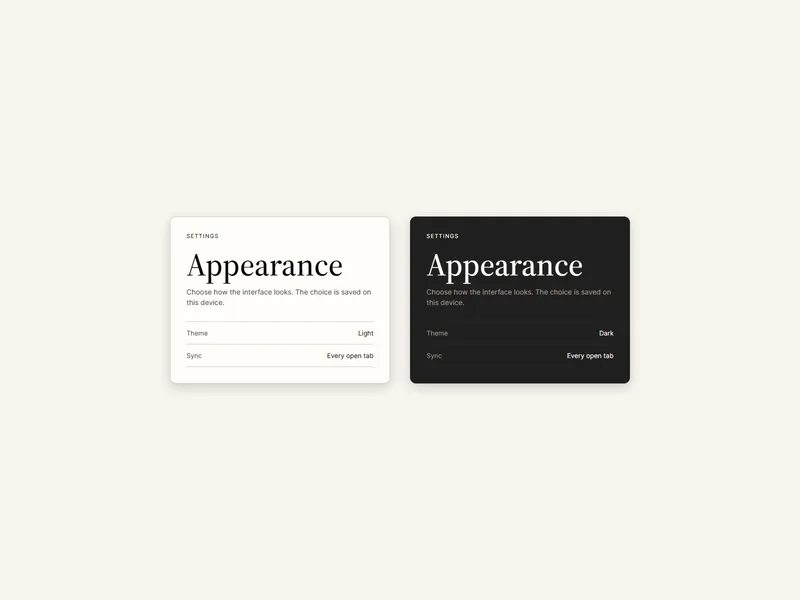
No-flash theme switch for Next.js
Light and dark mode that never flashes the wrong theme on load, remembers the choice and stays in step across tabs
- Next.js
- React

